



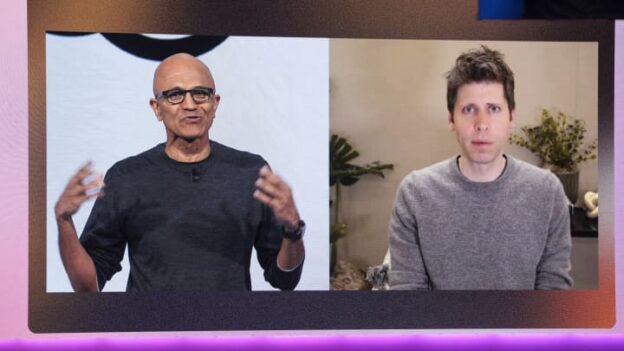
- OpenAI’s latest partnership with Amazon landed a day after the company restructured its relationship with Microsoft for the second time in six months.
- Denise Dresser, OpenAI’s revenue chief, said the “two are not related in any way.” But some analysts disagree.
- In February, Amazon said it would invest $50 billion in OpenAI, which will, in turn, bolster the amount it spends on AWS.
OpenAI revenue chief Denise Dresser said the AI company’s agreement on Tuesday to make its models available on Amazon had nothing to do with an announcement a day earlier that the startup had restructured its relationship with Microsoft for a second time in six months.
“The two are not related in any way,” Dresser told CNBC in an interview following OpenAI’s announcement with Amazon.
Analysts aren’t so sure.
A lot has happened since late October, when OpenAI completed its recapitalization, giving Microsoft a 27% stake in the for-profit side of the artificial intelligence company. As part of that arrangement, OpenAI agreed to purchase an incremental $250 billion of Azure services. And a revenue share agreement would remain until OpenAI was verified by an independent panel to have reached artificial general intelligence, or AGI.
One major development since then is that OpenAI has been cozying up to Amazon, Microsoft’s biggest rival in cloud infrastructure.
In November, OpenAI disclosed a $38 billion commitment with Amazon Web Services. And in late February, Amazon said it would invest $50 billion in OpenAI, which would, in turn, use 2 gigawatts worth of AWS’ custom Trainium chips for training AI models.
Amazon and OpenAI also agreed at the time to jointly develop “customized models” for Amazon’s engineering teams to power its consumer products, and OpenAI’s spending commitment on AWS expanded by $100 billion.
“That was the big thing that was happening,” said RBC Capital Markets analyst Rishi Jaluria, who recommends buying Microsoft shares, in an interview.
This week’s one-two punch is the starkest sign yet that a dramatic shift is underway in the decade-long relationship between Microsoft and OpenAI.
It started in 2016, when OpenAI began running its big experiments on Azure. Three years later, Microsoft invested its first $1 billion in OpenAI, a number that would grow to $13 billion over several follow-on rounds.
But in 2024, Microsoft started calling OpenAI a competitor in its financial disclosures, and early last year the software giant lost its designation as OpenAI’s exclusive cloud provider. In an internal memo earlier this month, Dresser wrote that OpenAI’s partnership with Microsoft has been “foundational to our success,” but “has also limited our ability to meet enterprises where they are.”
With that backdrop, the latest agreement between the two companies, “is looking to be quite fluid and for all we know could change again in six months,” UBS analysts wrote in a note Monday.
Additional elements of the deal include an end to Microsoft’s exclusive license to OpenAI’s intellectual property and to Microsoft’s revenue share payments to OpenAI. Microsoft will also no longer be the sole cloud provider for API products built with third parties.
“While some changes seem inevitable, Microsoft appears to have made more concessions than gains,” wrote the UBS analysts, who have a buy rating on Microsoft.
Amazon CEO Andy Jassy called Monday’s announcement “very interesting” in a post on X, adding that more details would be shared Tuesday.
Hours later, his company jumped in to announce a service for building AI agents with OpenAI models.
‘Original partner’

For years, developers interested in those models needed to go through Microsoft’s Azure cloud or work with OpenAI directly. Now companies with large AWS investments will be able to more easily adopt the models, while taking advantage of volume spending plans.
Dresser, speaking from an Amazon event, said the reworking of OpenAI’s arrangement with Microsoft was not inspired by the growing collaboration with Amazon.
“Microsoft is our original partner,” she said. “They’re an incredible partner to us. They will be a premier partner as we move forward. What we are focused on is making sure, as we meet our customers where they are, that they have access to environments that they’re working in. And we want to make sure that we deliver the best models in the best environments for customers to be successful.”
The Financial Times reported that Microsoft considered legal action regarding OpenAI’s plans with Amazon, and Microsoft told the newspaper that it was “confident that OpenAI understands and respects the importance of living up to [its] legal obligation.” Microsoft didn’t provide a comment beyond Monday’s announcement.
Microsoft is similarly making moves to diversify away from OpenAI.
In September, Microsoft said it was starting to draw on an AI model from Anthropic to answer some queries in the 365 Copilot assistant for commercial clients. Two months later, Microsoft agreed to invest up to $5 billion into Anthropic, which committed to purchasing $30 billion of Azure compute capacity.
Taking advantage of the surging popularity of Anthropic’s Claude Code, Microsoft announced in March an offering called Copilot Cowork in cooperation with Anthropic.
One downside of soaring demand for Claude is that reliability has suffered. The company reported partial or major outages during 37 of the past 90 days. Amazon, an early Anthropic partner and investor, has taken notice.
Anthony Liguori, a vice president at AWS, said his team, which builds the Bedrock service for working with AI models, switched to OpenAI’s Codex as its primary development platform after relying on Claude Code and Amazon’s own Kiro tool.
The reality for all the major parties involved is that they need each other.
Capacity is so constrained that OpenAI and Anthropic need to work with all of the major cloud vendors to secure as much compute as possible. And Microsoft and Amazon need simple access to all the major models to serve their massive customer bases.
So while Microsoft and OpenAI may be drifting apart, Jaluria was quick to note, “Microsoft still needs OpenAI, and OpenAI still needs Microsoft.”
Correction: A prior version of this story misspelled Dresser’s first name in the key points.
https://www.cnbc.com/amp/2026/04/29/openai-drift-from-microsoft-to-amazon-turns-aggressive-after-subtlety.html