



More info about SC25 at sc25.supercomputing.org. SC26 will take place in Chicago on 15-20 November 2026
Supercomputing 2025 (SC25) took place in St Louis on 16-21 November. The event has presented a vibrant and dynamic combination of high-performance computing, advanced networking and rapidly maturing quantum technologies. This year’s edition has demonstrated a clear shift from conceptual exploration towards deployable, integrated systems, including hybrid High Performance Computing (HPC)/quantum workflows, scalable optical networking innovations and sustainable data-centre design. For GÉANT and the European research community, SC25 highlighted a range of developments that will influence how research networks evolve in the coming years.
Quantum technologies reach a new level of maturity
 One of the remarkable features of SC25 was the visible maturity of quantum hardware. Several vendors demonstrated quantum computers designed for real operational environments rather than isolated laboratory settings. Photonic systems were particularly prominent, with some suppliers presenting rack-mountable quantum units suitable for standard data-centre deployments, and modular photonic processors that can be integrated into classical environments with relatively low overhead. Neutral atom and trapped-ion platforms were also well represented among European vendors, highlighting Europe’s growing influence in quantum processor development.
These trends signal a shift towards early commercialisation. Where quantum systems were once research prototypes, vendors are increasingly offering standardised, deployable solutions that could realistically interface with HPC centres, cloud platforms and future quantum networks. This evolution raises new questions for research networking, especially around timing synchronisation, data workflows and physical-layer integration.
Europe’s exascale breakthrough and TOP500 momentum

More broadly, Europe maintains impressive strength across the TOP500 rankings, with four additional systems in the global top ten: HPC6, Eni, Italy at 6th place; Alps, CSSC, Switzerland at 8th; LUMI, CSC/EuroHPC, Finland at 9th; and Leonardo, CINECA/EuroHPC, Italy at 10th.
JUPITER is already supporting more than 100 scientific projects, with outcomes including the simulation of a 50-qubit universal quantum computer and the modelling of the Earth system at 1-kilometre resolution. Its development module, JEDI, leads the Green500 among exascale-class systems, achieving 63 GFlops per Watt. The system operates entirely on renewable energy, and its waste heat is recycled into the Jülich campus heating network, making it a flagship example of sustainable supercomputing. This combination of performance, efficiency and environmental responsibility was widely commended at SC25 and reinforces Europe’s strategic position in global HPC.
Hybrid HPC/quantum workflows: from concept to practice
In addition to demonstrating increasingly powerful and versatile standalone quantum systems, SC25 featured substantial activity around hybrid HPC/quantum architectures. Many EuroHPC centres are now actively preparing for quantum integration, building pilot installations, developing scheduling concepts and working on hybrid workflows.
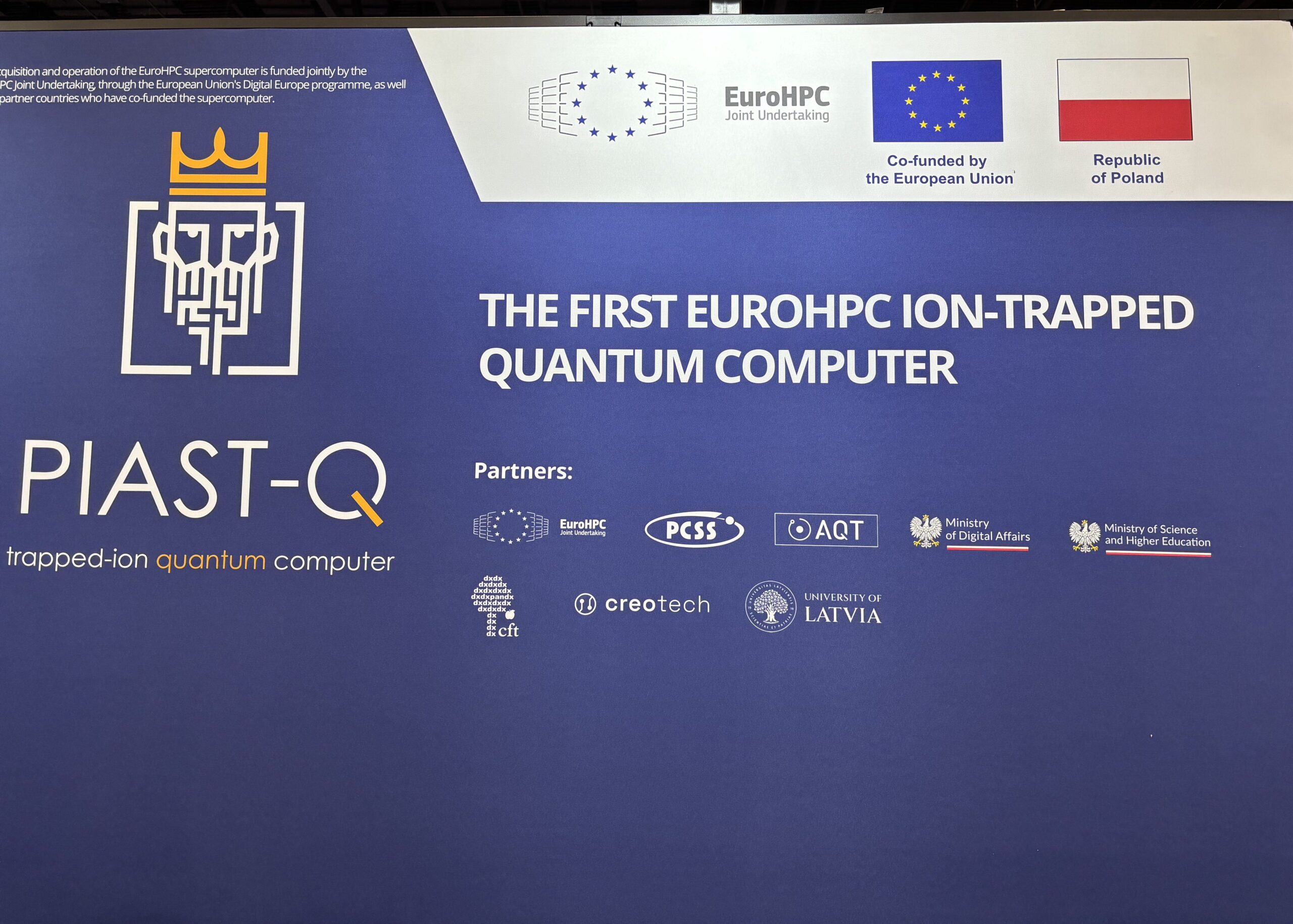
Discussions with PCSS, the Poznan Supercomputing and Networking Center, provided insight into their collaboration with AQT, an Innsbruck-based trapped-ion quantum processor developer. Their work focuses on quantum gravimetry and the practical aspects of hybrid classical/quantum execution, including orchestrating tasks between classical and quantum resources, investigating data movement requirements and evaluating performance across different quantum hardware platforms. This real-world experimentation marks an important step towards operational hybrid computing across Europe.
More broadly, interest in hybrid architectures was visible across the exhibition floor. HPC centres from multiple continents showcased early-stage integrations of quantum processors, and several vendors demonstrated software tools designed to streamline hybrid development, including transpilers, circuit compilers and orchestration systems. Applications of such systems include new material design, protein docking and new drug discoveries. These developments suggest a future in which quantum accelerators function as specialised HPC co-processors, extending the computational capabilities of existing infrastructure.
For GÉANT, these hybrid models are of particular importance. As quantum resources become more distributed, networks will play a critical role in providing deterministic, low-latency connectivity, reliable timing signals and potentially quantum-aware traffic engineering. SC25 highlighted how closely the evolution of HPC and networking are now intertwined.
Networking and optical technology advances
While quantum technologies generated considerable interest, SC25 also featured several developments in advanced networking, including optical switching, high-performance software-defined networking and next-generation programmable network fabrics.
Demonstrations of 800G and emerging 1.6T optical platforms illustrated the pace at which data rates are increasing. Several booths explored the use of optical circuit switching and dynamic bandwidth allocation to better support data-intensive science workflows. Instrumentation and monitoring tools also featured prominently, reflecting the increasing importance of visibility and telemetry in large-scale high-performance networks.
A common theme was the need for more intelligent, application-aware networking, capable of responding dynamically to the unique requirements of AI, hybrid HPC and large-scale scientific instruments – all valuable insights into the architectures and design models that may underpin future network services.
AI, HPC and scientific application innovations
SC25 also provided a platform for extensive discussion on the intersection of AI and HPC. The PRACE BoF session on AI in HPC emphasised that AI workloads are increasingly integrated into traditional supercomputing environments. Centres are exploring how foundation models, simulation-AI hybrids and domain-specific AI can augment scientific discovery.
In parallel, there was strong engagement from application communities, showcasing scientific use cases that push the limits of data movement and computational scale. This included demonstrations from physics, climate modelling, genomics and materials science, many of which require complex pipelines involving HPC, cloud and future quantum accelerators. These evolving workflows highlight the need for flexible and resilient research networks capable of supporting diverse computational environments.
Sustainability and green computing
Sustainability was another major theme at SC25. An interview with greendatacenter.se shed light on industry trends in energy efficiency, waste-heat recovery and low-impact cooling systems. Efficiency metrics are becoming integral to HPC procurement and operation, and Europe continues to lead in this area. Jülich’s EuroHPC system once again topped the Green500 ranking, demonstrating world-class performance per watt and reinforcing Europe’s position in sustainable HPC innovation.
Sustainability considerations are increasingly relevant to network architecture design, as energy consumption in networking equipment and data movement scales with traffic. SC25 made it clear that energy efficiency will become a systemic requirement across the entire research infrastructure ecosystem.
SC25 highlighted a research technology landscape undergoing rapid transformation. Quantum systems are maturing, hybrid HPC-quantum workflows are becoming viable, networking technologies are evolving to support data-intensive science at scale and sustainability is emerging as both a challenge and an opportunity for global research infrastructures. These developments reiterate the importance of strong international collaboration with European HPC centres, the broader quantum technology community and global scientific partners.
More info about SC25 at sc25.supercomputing.org. SC26 will take place in Chicago on 15-20 November 2026.
SC25 in St Louis: innovation, hybrid architectures and quantum technologies