



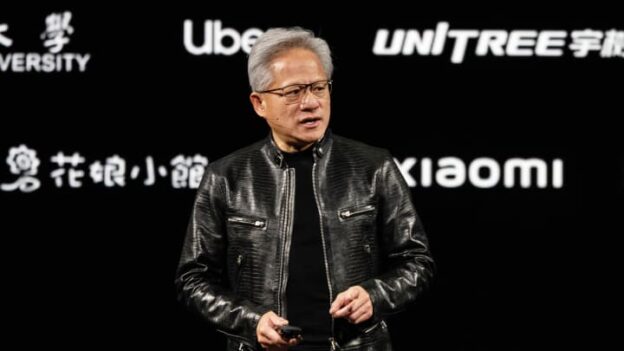
SEOUL, June 8 (Reuters) – Nvidia said on Monday that South Korean internet conglomerate Naver would use its technology to build AI factories at gigawatt scale to meet rising global demand for AI services and physical AI.
The project is aimed at serving growing global demand for AI services and physical AI applications, Nvidia said.
NVIDIA (NVDA, Financials) is expanding its AI ambitions through a new partnership with South Korea’s LG Group. CEO Jensen Huang said Nvidia is working with LG on humanoid robots and future data centers after meeting LG Group Chairman Koo Kwang-mo in Seoul.
The robotics work will focus on motor technology and mechanical systems. That matters because humanoid robots need more than powerful chips. They also need precise movement, strong hardware design and reliable control systems.
For Nvidia, the partnership fits into its broader push into physical AI, where software and chips help power robots, autonomous machines and industrial automation.
The companies are also working together on future data center architecture. That gives Nvidia another major industrial partner as global demand for AI computing infrastructure continues to rise.
Financial terms were not disclosed, so this is more of a strategic signal than an immediate revenue event.
For investors, the message is clear: Nvidia is not limiting its AI opportunity to GPUs. It is pushing deeper into robotics, data centers and real-world AI systems.
The next catalyst will be whether Nvidia and LG turn this partnership into commercial products or large-scale infrastructure projects.
NVIDIA (NVDA, Financials) is expanding its AI ambitions through a new partnership with South Korea’s LG Group. CEO Jensen Huang said Nvidia is working with LG on humanoid robots and future data centers after meeting LG Group Chairman Koo Kwang-mo in Seoul.
The robotics work will focus on motor technology and mechanical systems. That matters because humanoid robots need more than powerful chips. They also need precise movement, strong hardware design and reliable control systems.
For Nvidia, the partnership fits into its broader push into physical AI, where software and chips help power robots, autonomous machines and industrial automation.
The companies are also working together on future data center architecture. That gives Nvidia another major industrial partner as global demand for AI computing infrastructure continues to rise.
Financial terms were not disclosed, so this is more of a strategic signal than an immediate revenue event.
For investors, the message is clear: Nvidia is not limiting its AI opportunity to GPUs. It is pushing deeper into robotics, data centers and real-world AI systems.
The next catalyst will be whether Nvidia and LG turn this partnership into commercial products or large-scale infrastructure projects.