



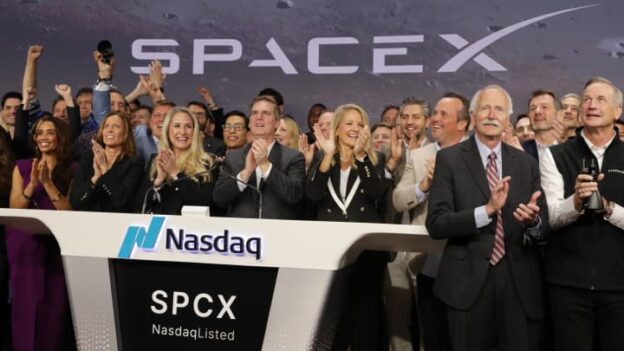
SpaceX is moving forward with a $40 billion (approximately ¥6.3 trillion) capital raise to fund purchases of Nvidia semiconductors. The plan calls for roughly $10 billion in bank loans and $30 billion in investment-grade bonds, with Apollo Global Management leading the effort and PIMCO among the institutions in talks to provide financing. The transaction is expected to close in 2027, though discussions remain in early stages. The company, which only completed its Nasdaq listing and inaugural bond issuance in June, is accelerating capital markets activity to fund massive investments in AI computing infrastructure — underscoring the intensifying competition for AI semiconductors.
SpaceX, the U.S. space exploration company, is advancing a capital raise of approximately $40 billion (about ¥6.3 trillion) to fund purchases of Nvidia semiconductors, the Financial Times reported on October 6, citing multiple people familiar with the matter.
The financing is expected to be led by Apollo Global Management, with plans to secure roughly $10 billion (about ¥1.6 trillion) through bank loans and $30 billion (about ¥4.7 trillion) through investment-grade bond issuance. Apollo is said to be assisting with the sale of bonds to a broad range of investors. According to sources familiar with the discussions, talks remain in early stages and the transaction could still fall through.
PIMCO, the major bond manager, is among the financial institutions in discussions to provide funding. The transaction is expected to close in 2027.
In August, Apollo joined a lending framework for AI computing infrastructure that Nvidia launched with six major asset managers. The initiative aims to mobilize more than $500 billion in third-party capital to fund Nvidia chip purchases for customer companies.
SpaceX, Apollo, Nvidia, and PIMCO did not immediately respond to Reuters requests for comment.
According to Bloomberg, SpaceX shares (SPCX) fell 1.2% to $169.79 in U.S. after-hours trading on October 6 following the report. Nvidia shares were roughly flat.
SpaceX, led by Elon Musk, continues to grow rapidly through its Starlink satellite communications service and rocket development. The company is reportedly pursuing large-scale procurement of Nvidia GPUs to expand its AI-related computing capacity.
SpaceX listed on the Nasdaq in June 2026 and issued $25 billion (about ¥3.9 trillion) in inaugural investment-grade bonds that same month. The weighted average interest rate was 5.855% with an average maturity of 11.7 years. Moody’s, S&P, and Fitch all assigned investment-grade ratings (Baa1, BBB, and BBB+, respectively), each with a “stable” outlook. The new investment-grade bond offering would exceed the initial $25 billion issuance in size.
Debt-fueled fundraising for AI computing infrastructure has spread across the industry. Nvidia issued $25 billion in bonds in June, Meta issued $30 billion in October 2025, Oracle plans to raise up to $50 billion in 2026, and Amazon has borrowed more than $80 billion since early 2025. SpaceX itself made capital expenditures of approximately $18.4 billion in the April–June 2026 quarter, of which roughly $15.8 billion went toward AI computing infrastructure.
| Company | Amount Raised | Timing | Structure |
|---|---|---|---|
| SpaceX (current) | $40 billion | Announced Oct 2026 | $10 billion bank loans + $30 billion investment-grade bonds |
| Oracle | Up to $50 billion | 2026 (planned) | Corporate bonds and equity |
| Meta | $30 billion | Oct 2025 | Investment-grade bonds |
| Nvidia | $25 billion | June 2026 | Corporate bonds |
SpaceX’s satellite business is also gaining prominence in the Japanese telecommunications market. SoftBank and NTT Docomo are advancing direct satellite-to-device collaborations with the company, and in August, KDDI became the first in Asia to sign a service agreement for the next-generation “Starlink Mobile V2” satellite, aiming to launch voice call services in 2027.
Nvidia semiconductors have become the de facto standard for AI computing, with demand continuing to far outstrip supply. SpaceX’s large-scale procurement highlights the intensifying competition among companies for AI infrastructure.
https://finance.biggo.com/news/33581abb-a682-4180-90a7-a11fc5b15417?shem=aimgspe,
