



NZ in uncomfortable company at climate summit, as fuel company bosses deny importance of phasing out oil, gas and coal
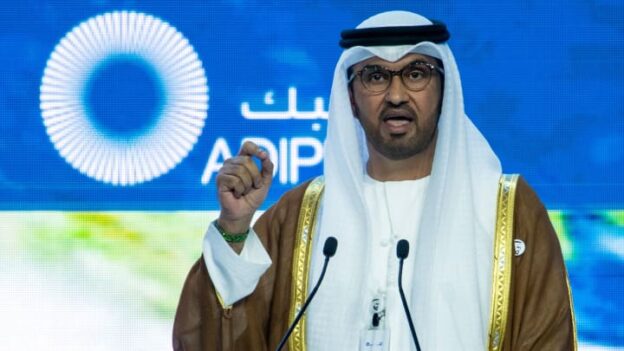
The United Arab Emirates’ credibility as host and president of COP28, the UN’s climate negotiations, was seriously dented this weekend by a report of comments from Sultan Ahmed Al-Jaber, chair of the negotiations and chief executive of the United Arab Emirates’ state-owned oil company.
There is “no science” to indicate a rapid, deep reduction in fossil fuel emissions is required to limit the rise in global temperatures to 1.5C, he said in an online climate conference on November 21.
His comment completely contradicted extensive science catalogued by, for example, the Intergovernmental Panel on Climate Change, the United Nations body that co-ordinates thousands of climate scientists around in the world to produce its periodic Assessment Reports.
‘Sending us back to caves’ is the oldest of fossil fuel industry tropes: it’s verging on climate denial‘
Bill Hare, Climate Analytics
Further evidence was tabled yesterday at COP28 by a large consortium of science institutions. “I cannot see scientifically there being any other communication than that we need to phase out fossil fuels,” said Professor Johan Rockström, director of the Potsdam Institute of Climate Impact Research, which was one of the contributors.
Persistent questioning by Mary Robinson, a former president of Ireland, prompted Al-Jaber’s increasingly annoyed responses, the Guardian newspaper reported, with a link to a video recording of their exchange.
“This is an extraordinary, revealing, worrying and belligerent exchange,” said Bill Hare, chief executive of Climate Analytics, which produces the authoritative Climate Action Tracker of nations’ climate commitments.
The Climate Action Tracker concludes New Zealand’s goals and delivery, too, are “highly insufficient”.
“‘Sending us back to caves’ is the oldest of fossil fuel industry tropes: it’s verging on climate denial,” he said.
Al-Jaber also asked Robinson: “Please help me, show me the roadmap for a phase-out of fossil fuel that will allow for sustainable socioeconomic development, unless you want to take the world back into caves.”
Yet, the International Energy Agency, part of the OECD, produced for COP28 yet another Net Zero Roadmap of how nations can transition rapidly from fossil fuels to clean energy to meet the 1.5C target. The last few years, for example, “have seen remarkable progress in developing and deploying some key clean energy technologies.”
The United Arab Emirates is “facing a moment of truth now” in Dubai. “Is it going to be partnering with the rest of the world?” asks Fatih Birol, executive director of the International Energy Agency. “Or is it going to stick to their business plans?”
Al-Jaber’s comments will likely undermine the UAE’s strategy of launching a raft of non-binding climate initiatives in the first few days of COP28 in an attempt to stem the tide of support for a phase out of fossil fuels.
Its key initiative, launched on Saturday, is the Global Decarbonisation Accelerator. Its three main elements are a tripling of renewable energy capacity and a doubling the rate of energy efficiency improvements by 2030; scaling up efforts to decarbonise industrial sectors; and reductions in methane and other non-CO2 greenhouse gases.
The signatories to the accelerator add “up to more countries and more companies from more sectors than ever before, all aligning with our North Star of 1.5C,” Al-Jaber said when he launched at the World Leaders’ Climate Action Summit on Saturday.
While there are many beneficial elements in the Accelerator, the UAE’s concept of a 1.5C strategy clearly includes only modest commitments from fossil fuel companies. They are, for example, only pledging to reduce emissions from their own production. They are making no commitments on the other 80-95 percent of emissions (depending on the company) generated when their fuels are used.
Moreover, the UAE has some of the most ambitious plans among petrostates to expand its fossil fuel production. Adnoc, its state-owned company of which Al-Jaber is chief executive, is planning to increase its drilling programme by up to 32 percent by 2030, Rystad Energy, a leading research company, reported recently. Only Saudi Arabia had more ambitious plans, it said.
The case for fossil fuels playing major roles in the transition to clean energy was also made by Darren Woods, chief executive of ExxonMobil, the world’s largest private sector producer.
Coming to a COP for the first time, he said too much emphasis had been placed on “the electron solution” of renewable electricity.
Discussions had “put way too much emphasis on getting rid of fossil fuels, oil and gas, and not…on dealing with the emissions associated with them,” he said in an interview with the Financial Times.
“The transition is not limited to just wind, solar and EVs. Carbon capture is going to play a role. We’re good at that. We know how to do it, we can contribute. Hydrogen will play a role. Biofuels will play a role.”
This is, however, an excessively optimistic view of carbon capture, usage and storage, which fossil fuel producers are making very limited use of to date, mostly by injecting gasses into wells to produce more oil and gas.
Far more challenging is capturing carbon from the atmosphere after the fossil fuels have been burnt. Given the inefficiency, cost and complexity of those technologies, they capture barely 0.1 percent of global emissions currently, and estimates of their future role are very modest, the World Resources Institute concludes.
New Zealand made a brief appearance in yesterday’s fossil fuel debate. It won the first Fossil of the Day award of this COP for the National-led government’s campaign promise to revoke the previous government’s ban on offshore oil exploration beyond Taranaki’s coastal waters.
The government was making “a U-turn on the way to a liveable future,” said the Climate Action Network, which made the award. CAN involves some 1,100 NGOs in more than 120 countries.
While fossil fuels featured prominently yesterday, health was one of the designated themes of the day for the first time at a COP. Among many initiatives announced, more than 120 countries signed the UAE Climate and Health Declaration.
The Declaration urges governments to act to protect communities and prepare health systems for climate impacts, such as extreme heat stress and increased spread of infectious diseases. “The climate crisis is a health crisis,” said Tedros Ghebreyesus, director-general, World Health Organisation.
A reflection on the importance of this theme to New Zealand was offered in this piece on The Conversation by Professor Alistair Woodward of the University of Auckland’s School of Population Health.
He argues that health must play a dual role at the centre of climate policy. Successful mitigation and adaptation will reduce the adverse health impacts on people’s lives; while good solutions such as higher urban density done well and higher environmental standards bring health benefits.
But some policies in both categories are heading in the opposite direction in New Zealand.
NZ wins COP28 ‘fossil’ award for revoking offshore oil exploration ban