



The $150 Trillion Global Economy in 2030
Key Takeaways
- The global economy is projected to expand by nearly $25 trillion between 2026 and 2030.
- The U.S. ($37.7 trillion) and China ($26 trillion) will remain the world’s largest economies by 2030.
- Germany and India are projected to be virtually tied for third place, separated by just $5 billion.
The world economy is projected to exceed $150 trillion by 2030, with significant growth coming from emerging markets in Asia.
This visualization shows countries’ projected nominal gross domestic product (GDP) in 2030, based on forecasts from the International Monetary Fund’s World Economic Outlook.
The World’s Largest Economies in 2030
The three largest national economies in 2030 are projected to be the same as in 2026. The United States leads at $37.7 trillion, followed by China at $26 trillion and Germany at a distant third with $6.2 trillion.
Combined, these three economies are projected to add more than $10 trillion in economic output between 2026 and 2030, led by China.
The table below lists the world’s economies by forecast nominal GDP in 2030.
|
Rank
|
Country
|
2030 GDP (billions $)
|
Share of World Economy
|
|---|---|---|---|
| 1 | 🇺🇸 United States | 37,678 | 25.1% |
| 2 | 🇨🇳 China | 26,047 | 17.3% |
| 3 | 🇩🇪 Germany | 6,178 | 4.1% |
| 4 | 🇮🇳 India | 6,173 | 4.1% |
| 5 | 🇬🇧 United Kingdom | 5,148 | 3.4% |
| 6 | 🇯🇵 Japan | 5,002 | 3.3% |
| 7 | 🇫🇷 France | 4,004 | 2.7% |
| 8 | 🇧🇷 Brazil | 3,204 | 2.1% |
| 9 | 🇮🇹 Italy | 3,046 | 2.0% |
| 10 | 🇨🇦 Canada | 3,008 | 2.0% |
| 11 | 🇷🇺 Russia | 2,592 | 1.7% |
| 12 | 🇲🇽 Mexico | 2,549 | 1.7% |
| 13 | 🇦🇺 Australia | 2,484 | 1.7% |
| 14 | 🇪🇸 Spain | 2,472 | 1.6% |
| 15 | 🇰🇷 South Korea | 2,267 | 1.5% |
| 16 | 🇮🇩 Indonesia | 2,082 | 1.4% |
| 17 | 🇹🇷 Türkiye | 1,934 | 1.3% |
| 18 | 🇳🇱 Netherlands | 1,655 | 1.1% |
| 19 | 🇸🇦 Saudi Arabia | 1,650 | 1.1% |
| 20 | 🇵🇱 Poland | 1,388 | 0.9% |


IMF forecasts not available for Afghanistan, Bolivia, Cuba, Eritrea, Lebanon, North Korea, Pakistan, Sri Lanka, Syria, and Venezuela.
The race for third place is remarkably close. Germany is projected at $6.178 trillion in 2030, compared with $6.173 trillion for India, a difference of just $5 billion.
India could soon overtake Germany in nominal GDP if current growth trajectories continue. The ranking looks very different when adjusting for purchasing power parity, where India’s economy is already roughly three times the size of Germany’s.
The Rise of Asia
By 2030, Asia and the Middle East are projected to generate $55.7 trillion in economic output, accounting for more than a third of the global economy.
Japan will be the region’s next-largest economy after China and India, at $5 trillion, followed by South Korea ($2.3 trillion) and Indonesia ($2.1 trillion).
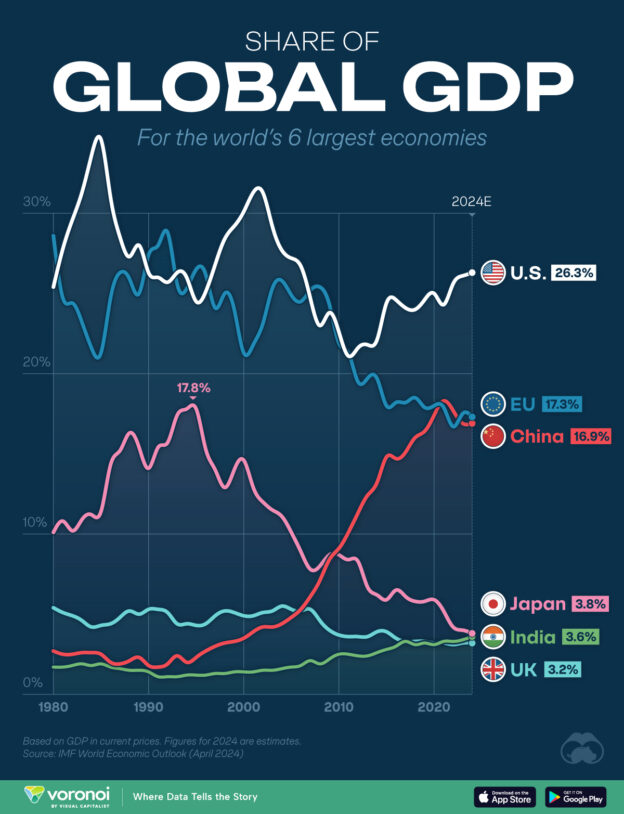
The long-stagnating Japanese economy has seen growth sputter in recent decades. Once the world’s second-largest economy, Japan was surpassed by China in 2010 and Germany in 2024.
Europe: The Balanced Economy
Europe’s $37 trillion economy is projected to be one of the world’s most balanced by country in 2030. By comparison, a single country accounts for more than half of the continental economy in both North and South America.
Europe is projected to account for roughly a fifth of the global economy in 2030. Assuming no new additions or withdrawals, European Union member countries will reach a combined nominal GDP of $26.5 trillion, led by Germany, France ($4 trillion), and Italy ($3 trillion).
Meanwhile, the United Kingdom ($5.1 trillion) will remain the continent’s largest non-EU economy, followed by Russia ($2.6 trillion). Russia is among the few major economies expected to contract between 2026 and 2030.
https://www.visualcapitalist.com/the-150-trillion-global-economy-in-2030/