



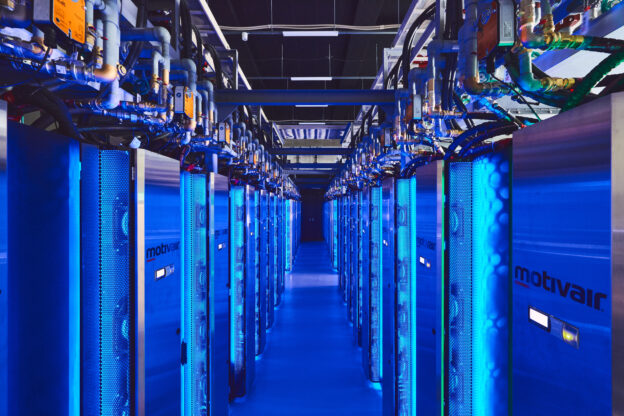
As AI workloads grow more complex and environmental considerations push data centers toward more responsible operation, the need for smart, sustainable, and scalable cooling is fast becoming a core requirement
The high-density compute and energy-intensive workloads of AI and machine learning have made sole reliance on traditional cooling methods unrealistic. The scale and complexity of AI-driven operations are pushing the boundaries of what conventional air cooling can manage. As the demand for AI and machine learning accelerates, data centers are being asked to do more, faster, and with greater efficiency.
The shift towards liquid cooling is well underway, and with the rapid adoption of AI showing no signs of slowing down, smart, flexible, and scalable solutions are essential to support this new generation of high-performance data centers.
Liquid cooling methods provide significantly more efficient heat removal and control compared to conventional air-cooled systems, enabling better thermal management and reduced energy consumption. At a time when data centers are under increasing pressure to prioritize sustainability, manage water resources, and reduce environmental impact, next-generation intelligent cooling solutions have never been more important.
This year, Belimo celebrated its 50th anniversary, marking five decades of innovation and success in the commercial HVAC industry. With a proven track record and extensive expertise in building climate control, the company has been channeling its knowledge into the data center space for 20 years. Belimo continues to step up to meet the critical challenge of efficient, reliable, and sustainable cooling for the new era of high-density, future-ready facilities.
Riding the wave of liquid cooling, Howard Smith, lead regional business development manager of data centers at Belimo Americas, explores how the company is helping data center operators to scale up and cool down efficiently, with its smart control valves and customer-first approach to design and deployment.
Charting the rise of liquid cooling
The conversation around liquid cooling has rapidly evolved from speculative future tech to an industry necessity. The increasing demand for cooling systems that can manage the intense heat output of high-density servers, particularly in AI applications, is driving widespread adoption of liquid-based and hybrid systems. Smith outlines the key shift:
“For a long time, people have been saying that liquid cooling is coming, and then all of a sudden, like a switch, liquid cooling is here,” he says. “Things are moving very fast, and what’s scary but incredibly exciting is that we’re just getting started.”
This is no longer a matter of if or when. The emergence of hardware like Nvidia’s GB200 superchip has made the physics unavoidable – some workloads simply cannot be cooled by air alone. The reality of high-wattage components, including those used for large-scale AI training and inference, has forced operators to confront the limitations of traditional cooling.
“Liquid cooling has always been around – it’s existed in personal computers, for example. But in the data center space, it was more of a choice,” explains Smith. “Now, with GB200s and future 1MW rack deployments on the horizon, liquid cooling is no longer a choice, it’s a requirement.”
The evolution of hardware has outpaced the capabilities of legacy infrastructure, making innovation in thermal management non-negotiable. What’s more, as more organizations race to deploy generative AI and large-scale machine learning models, cooling systems must now be both scalable and predictive, ready to adjust in real time to fluctuating demands.
Balancing legacy and innovation
While liquid cooling offers many advantages, traditional air-cooled systems are by no means obsolete. Many facilities still operate effectively with air-based setups, and the ideal approach often depends on variables such as geography, workload type, and scalability goals. Hybrid models are gaining traction for their ability to bridge the gap between old and new.
“While I believe that liquid cooling is perhaps the fastest growing segment in the industry today, there still are traditional data centers out there that might not need that same level of cooling just yet,” notes Smith.
Flexibility is essential. Belimo’s portfolio allows customers to adopt air, liquid, or hybrid cooling, depending on their current and future requirements. Rather than pushing a one-size-fits-all approach, Belimo works collaboratively with operators to understand their unique demands and identify the right cooling approach.
“The first thing we ask is, what are your needs? What is your application? And then we develop a solution together that’s the best fit,” says Smith. This customer-centric mindset ensures that cooling systems are the right fit for both technical and budgetary needs, enabling facilities to transition smoothly when the time comes to upgrade or expand.

“We’re not afraid to invest in R&D or new product lines if that’s what’s needed to meet a customer’s requirement,” adds Smith. “That’s what long-term partnership looks like, and it continues into our after-sale support.”
Belimo’s holistic approach empowers facilities not only to meet today’s demands but to stay future-ready, ensuring that evolving cooling needs can be addressed without disruption to core operations or infrastructure overhauls.
Solving the cooling puzzle: Smart control valves
At the heart of Belimo’s innovation strategy are its smart control valves – critical components often overlooked in the broader cooling equation. These devices are key to maintaining system balance and efficiency.
“We don’t just make on-and-off valves,” emphasizes Smith. “We invest heavily, about eight percent of our revenue, back into R&D to ensure our valves come equipped with the latest control logic, features, and reliability enhancements.”
The EPIV (Electronic Pressure Independent Valve) exemplifies this commitment. It includes an ultrasonic flow meter and an integrated temperature sensor that allows for real-time data gathering. This precision makes it easier to maintain optimal flow rates, particularly important in high-stakes, high-heat environments.
The networkable device means that users can rewrite the capacity of the valve as needed – providing built-in flexibility that adapts as the cooling needs of the facility scale up for future-ready operations. “Rather than sending it a specific valve position, you send it a flow rate based on the system’s load. The valve then modulates to maintain that flow,” says Smith.
This eliminates risk of undercooling – an issue that could otherwise result in thermal stress or hardware failure. Plus, the EPIV can be pre-calibrated at the factory, reducing commissioning time and simplifying installation.
Additionally, the EPIV can monitor glycol concentration. While adding glycol to the system is a common method to prevent bio growth, too much can decrease efficiency. The device ensures that only the precise amount of glycol required is what’s used – preventing bio growth and optimizing performance. This monitoring and precise control is critical in maintaining both system hygiene and thermal efficiency.
The next level of intelligence comes from the Belimo Energy Valve, which includes all the features of the EPIV with added functionality. With a second temperature sensor, the valve can calculate Delta T and thus the exact thermal energy transfer. This transparency gives operators a deeper understanding of system performance.
“With power over Ethernet, Modbus TCP/IP, and differential pressure control, the Energy Valve provides both data and control. It also adapts the flow across the rack to provide overflow prevention,” explains Smith. For instance, if pressure increases due to the removal of a server blade, the valve adjusts instantly – this extends the lifespan of the components, reduces the need for maintenance, and ensures uninterrupted operations.
More importantly, these valves provide operators with an abundance of critical real-time data, including flow, valve position, differential pressure, supply and return temperature, Delta T, glycol percentage, and power – making it easier to spot inefficiencies and proactively respond to faults before they escalate.
Cooling sustainably
Cooling efficiency isn’t just about performance – it’s about sustainability too. With data centers now representing a significant portion of global energy consumption, smarter cooling is integral to the decarbonization of digital infrastructure.
One of the key opportunities lies in variable flow – delivering the right amount of coolant at the right time, rather than at maximum flow 24/7. This targeted delivery improves energy efficiency and reduces operational costs.
“Our valves allow flow to be fine-tuned and controlled down to the rack level. Rather than overflowing just to be safe, our valves allow operators to define specific flow or differential pressure set points based upon design load at the rack level. If the application doesn’t require the full flow of the valve, you shouldn’t be using it,” says Smith.
Moreover, liquid cooling systems are typically closed loop, meaning water is reused, not consumed. “Unlike evaporative cooling towers, once liquid cooling systems are filled, they just cycle. That’s a huge advantage when it comes to water conservation,” adds Smith.
Looking ahead
The data center industry is in a state of rapid transformation, and nowhere is that more apparent than in cooling technologies. The emerging possibility of 1MW racks has already triggered deep conversations about thermal management strategies for ultra-high-density environments.
“The biggest challenge is also perhaps the biggest opportunity,” says Smith. “Those who can innovate to meet it will shape the future of the industry.”
Belimo’s plan is clear: continue to invest, innovate, and co-create with customers to ensure that its cooling solutions evolve alongside the industry’s most advanced workloads. “We want to be the company that has the solution in place when 1MW racks become mainstream,” says Smith.
As AI workloads grow more complex and widespread, and environmental considerations push data centers toward more responsible operation, the need for smart, sustainable, and scalable cooling will become not just a competitive advantage, but a core requirement.
Belimo’s investment in smart control technology, customization, and sustainability reflects the future of data center cooling – where innovation is no longer optional, but essential for enabling the next generation of computing.
https://www.datacenterdynamics.com/en/marketwatch/the-future-of-cooling-scaling-up-sustainably-with-smart-liquid-solutions/