



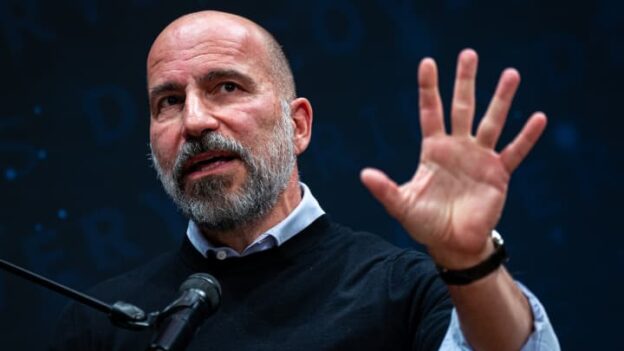
In the age of artificial intelligence and the race to popularize autonomous vehicles, Uber CEO Dara Khosrowshahi isn’t betting on long-term plans, he said in an interview for an episode of CNBC’s “Leaders Playbook,” set to air on Wednesday.
“If you think you’re planning five years into the future, you’re kidding yourself,” Khosrowshahi said. All you can do is be honest with yourself, your team and “prepare yourself for the probabilities.”
Khosrowshahi considers autonomous vehicles in more cities to be a probability for his company at some point, he said. Uber has inked corporate partnerships with companies like Waymo to work toward making self-driving cars more accessible to consumers, he added.
But nobody knows exactly how long it’ll take for autonomous vehicles to become any kind of norm — so instead of spending most of his time trying to plan for a specific timeline, Khosrowshahi spends “60 to 70%” of his days prioritizing “the near term” future, he said.
For Khosrowshahi, that means spending a majority of his time focusing on smaller day-to-day details or objectives that are six months out, he said. “We’re constantly, as a company, grinding to get better and better in the little details of everything that we do,” said Khosrowshahi. “I get to have fun with the other 30% of my time thinking about the long term.”
DON’T MISS: How to build custom GPTs and use AI agents
Focusing most of your time on short-term goals is generally seen as a good practice, psychologists and psychotherapists say — whether you’re running a large company or otherwise. Checking off daily or weekly goals is more motivating and less likely to be derailed by other commitments, financial psychologist Charles Chaffin told CNBC Make It in on Dec. 23.
“Even a one-year time horizon is too far in the distance,” Chaffin said. “You can have a one-year time horizon, but you need to have a bunch of intermediate [targets] in between.”
Setting and achieving short-term goals can also help clarify what’s actually in your control, a mindset that can help your long-term growth, psychotherapist Amy Morin wrote on Jan. 14. For example, Morin likes to ask herself, “What did I do to grow mentally stronger today?” she wrote.
“There’s a lot you can’t control in life — other people’s actions, unexpected setbacks, the weather,” wrote Morin. “This question reminds you to focus instead on the actions you took. Rather than ruminating about what went wrong, you’re celebrating what you did right. This shifts your energy toward solutions and empowers you to keep improving.”
For Khosrowshahi’s part, he may not be able to predict the next decade — but he can try to prepare his team to be ready for challenges, he said.
“I am good at developing people, and part of that development is getting to know them, listening then throwing challenges in front of them and seeing how they do,” Khosrowshahi said. “You want to save them if they’re struggling, but unless you’re challenging your executives, they’re never going to develop.”
Watch Uber’s Dara Khosrowshahi on CNBC’s “Leaders Playbook″ on Wednesday, Jan. 14 at 10:00 p.m. ET/PT. All new episodes Wednesdays.
Want to get ahead at work with AI? Sign up for CNBC’s new online course, Beyond the Basics: How to Use AI to Supercharge Your Work. Learn advanced AI skills like building custom GPTs and using AI agents to boost your productivity today. Use coupon code EARLYBIRD for 25% off. Offer valid from Jan. 5 to Jan. 19, 2026. Terms apply.
https://www.cnbc.com/amp/2026/01/13/uber-ceo-nobody-can-plan-5-years-into-the-future-what-to-do-instead.html