



It’s officially the beginning of a new era for one of Wall Street’s most prized public companies. Warren Buffett’s Dec. 31 retirement as CEO of Berkshire Hathaway (NYSE:BRKA)(NYSE:BRKB) paved the way for his protégé, Greg Abel, to take the reins. Although Buffett remains chair of Berkshire’s board, it’s Abel now overseeing the company’s day-to-day operations and its $360 billion investment portfolio.
Abel was quick to make his mark, with Berkshire’s new boss jettisoning 16 positions from the portfolio in the first quarter.
Missed Nvidia in 2009? This Rare Signal Is Flashing Again. In 2009, a “Double Down” signal flashed for a little-known chipmaker called Nvidia. For the first time in years, that same “Total Conviction” signal is flashing for a company 1/100th the size of Nvidia. Continue »

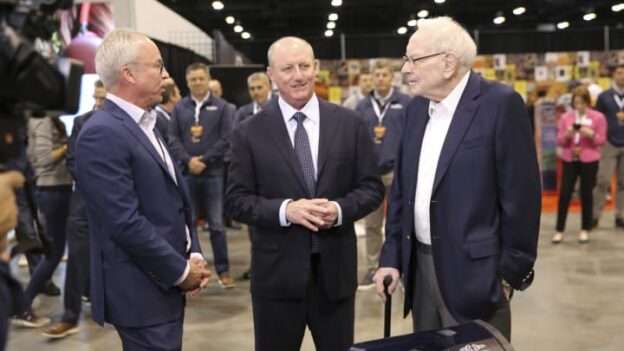
Warren Buffett retired as Berkshire’s CEO on Dec. 31. Image source: The Motley Fool.
But the one clear carryover from the Oracle of Omaha to Abel is portfolio concentration. Both of Berkshire’s bosses strongly believe in concentrating their company’s invested capital in their best ideas. As of the closing bell on Sept. 4, Warren Buffett’s successor had nearly 82% (almost $294 billion) of Berkshire Hathaway’s invested assets in just 10 superstar stocks:
-
Apple (NASDAQ:AAPL): $72.93 billion (20.2% of invested assets)
-
American Express (NYSE:AXP): $49.45 billion (13.7%)
-
Alphabet (NASDAQ:GOOGL)(NASDAQ:GOOG): $35.78 billion (9.9%, both share classes combined)
-
Coca-Cola (NYSE:KO): $35.23 billion (9.8%)
-
Bank of America (NYSE:BAC): $30.3 billion (8.4%)
-
Chevron (NYSE:CVX): $17.6 billion (4.9%)
-
Occidental Petroleum (NYSE:OXY): $15.91 billion (4.4%)
-
Mitsubishi (OTC:MTSUY): $12.85 billion (3.6%)
-
Moody’s (NYSE:MCO): $12.18 billion (3.4%)
-
Chubb (NYSE:CB): $11.7 billion (3.2%)
Tech stocks are on the menu
Perhaps the most noticeable difference between Berkshire’s portfolio under Abel compared to Warren Buffett is that tech stocks are officially on the menu under new management. In addition to Apple retaining its top spot, Abel has piled into Google parent Alphabet since the year began.
Although Alphabet has an especially safe foundation, given the Google search engine’s virtual monopoly in global internet search traffic, it’s the company’s artificial intelligence (AI) ambitions that are truly exciting. Since integrating generative AI and large language model capabilities into Google Cloud, sales for this considerably higher-margin segment have gone parabolic. Google Cloud registered 82% year-over-year sales growth in the June-ended quarter.
Financial stocks are still a pillar of Berkshire’s portfolio
Even though Warren Buffett is no longer steering the ship, financial stocks remain a key part of Berkshire’s long-term investment approach. Collectively, American Express, Bank of America, Moody’s, and Chubb make up close to 29% of Berkshire’s invested assets.
The beauty of financial stocks is their cyclical ties. Even though financial companies struggle during inevitable economic slowdowns and recessions, the non-linear nature of economic cycles strongly favors patient investors like Buffett and Abel. For instance, long-winded economic expansions allow Amex and BofA to prudently lend capital and generate meaningful interest income.

Image source: Getty Images.
Buffett’s “indefinite” holdings aren’t going anywhere
Lastly, Berkshire Hathaway’s highly concentrated positions drive home the idea that Warren Buffett’s “indefinite” holdings aren’t going anywhere.
In the Oracle of Omaha’s 2023 letter to shareholders (released in early 2024), he outlined eight stocks he viewed as indefinite/forever holdings. This included Coca-Cola, Amex, Occidental Petroleum, and all five Japanese trading houses, Mitsubishi among them.
While some of these companies are long-tenured holdings with otherworldly yields on cost, such as Coca-Cola and Amex (held since 1988 and 1991, respectively), they all represent relatively safe, reasonably valued, dividend-paying businesses that can benefit from global economic growth.
https://finance.yahoo.com/markets/stocks/articles/warren-buffetts-successor-greg-abel-092601522.html?shem=aimgspc,