



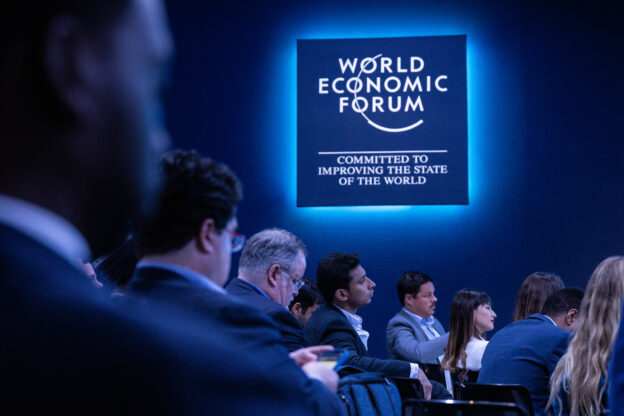
In Davos, the 2024 World Economic Forum warns that cooperation on peace and security issues is declining.
Hello from Davos, where the World Economic Forum annual meeting is in full swing and there is a bit of a fin de siècle feeling among top participants. It doesn’t bode well for the rules-based global order in which Davos came to prominence—or the borderless business models of large, multinational companies that still dominate the pop-up storefronts of the town’s main street.
On the one hand, Davos is brimming with energy levels rarely seen before. Judging by the number of side events and the sheer number of people who have ascended to the Alpine town, Davos seems to be in its heyday. I’ve been here every year since 2013 (except the COVID year of 2021) and never have I seen so many people and sensed so much enthusiasm among participants.
On the other hand, among organizers and principals, there’s a palpable sense of fear and concern. Globalization—as measured by trade as a percentage of global GDP—is in reverse. Geopolitical cooperation has given way to geostrategic competition and war. Misinformation and disinformation threaten to put isolationists in power from Washington to Brussels.
In the past, optimism often prevailed in Davos, especially as the week went on. Seeing like-minded people and hearing how they’re navigating headwinds can have a cathartic effect. But this year, the World Economic Forum itself added to the undercurrent of doom when it published its first “Global Cooperation Barometer” with McKinsey last week, which showed that cooperation on peace and security, as well as health, is in decline. The world’s disjointed response to COVID and Russia’s war in Ukraine are the greatest examples of the trend, which also is apparent in the crumbling power of organizations like the UN and NATO.
But for European business and political leaders, the most worrying trend may be that the model of economic trade and interdependence they subscribed to after WWII is also on the verge of collapse. Parts of Europe are already paying the price. The Port of Antwerp for example, one of Europe’s largest ports and Germany’s gateway to the world, reported a 5.5% decline in throughput in 2023. “We are the center of economic and geopolitical challenges worldwide,” CEO Jacques Vandermeiren said of the results.
The larger picture is even more worrisome for Europe and its companies, WEF president Børge Brende told me on the eve of Davos. “The biggest question we’re faced with is whether we’ve left the post-war order and entered a new multipolar world order but without traffic rules and multilateralism,” he said, echoing a point he made in a Fortune commentary piece this week.
In the 1990s and 2000s, of course, we lived in a unipolar world, underpinned by the U.S. and its hegemony. With the rise of China and the return of regional powers such as Russia, we’re back to multiple poles in geopolitics and economics. That’s fine if it’s accompanied by multilateral cooperation, Brende said, but troublesome if it’s not.
“If you don’t have multilateralism, you’re back to Europe in the 19th century,” he said. “There was a lot of multipolarity, but not a lot of peace.”
https://fortune.com/europe/2024/01/16/wef-president-warns-global-cooperation-falling-peace-19th-century-europe/amp/