



NVIDIA’s latest breakthroughs could show where the money is really going…
Most investors think they understand where artificial intelligence is headed.
They picture faster chips. Bigger data centers. Smarter software living on screens and servers.
But at the Consumer Electronics Show (CES) in Las Vegas this week, we got a different look at where things are really going.
You see, AI is quietly reaching a turning point. And we may look back on 2026 as the year when AI crosses over into the physical realm.
In fact, CES has a long history of marking inflection points like this.
Years ago, it was the compact disc (CD).
Then the VCR.
Later, the original Xbox.
I could go on. The point is, at the time, they looked like new tech gadgets. But in reality, they marked pivotal moments – moments when technology moved into everyday life and reshaped entire industries.
That’s what happened again this year.
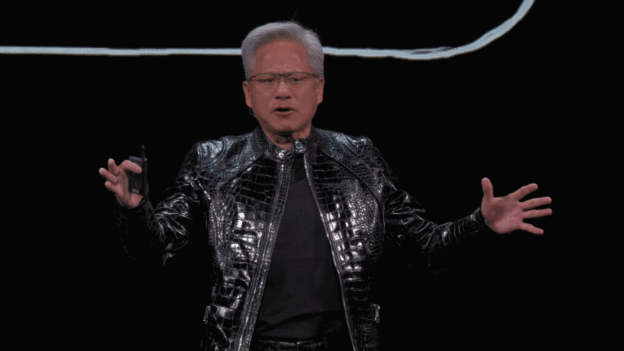
NVIDIA Corporation (NVDA) CEO Jensen Huang put it plainly when he said, “The ChatGPT moment for physical AI is here.”
So, in today’s Market 360, I’ll tell you all about some key highlights from CES, what they mean for this next phase of the AI Revolution and how it signals a change in tech leadership.
Make no mistake, this is a really big deal, folks. A lot of people could lose money by ignoring market shifts like this, but it’s also a great opportunity to profit. So, to wrap things up, I’ll explain how you can avoid the “hidden crash” that I see coming – and what to do to profit.
The Future Has Arrived
First, one of the biggest announcements at CES came from Huang when he introduced its next-generation AI chip, Vera Rubin. It’s made up of six chips, combining a Vera central processing unit (CPU) and two Rubin GPUs. These graphics processing units are designed to deliver five times greater performance and 10 times lower cost per query than NVIDIA’s current Blackwell chips.
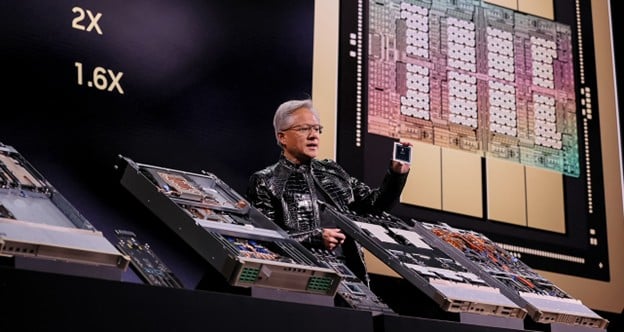
In other words, it will drastically lower the cost of utilizing AI – which means it will spread even faster.
Huang said that Rubin is in full production and is expected to be delivered to customers later this year.
The next big announcement focused on robotics – more specifically, autonomous vehicles (AVs).
Huang introduced Alpamayo, a portfolio of AI models designed for vehicles with “Level 4 autonomy,” which means no driver is needed, but only in approved areas.
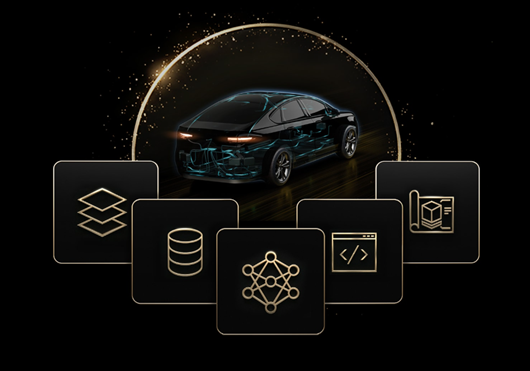
With Alpamayo, vehicles will be able to think and make human-like judgments in complex road situations. For example, if a traffic light goes out at a busy intersection, it’ll tell you the action it’s going to take and the reason why it’s doing it.
Huang explained that he is talking to robotaxi operators in the hopes of having them use NVIDIA’s chips and AV software to power their AVs as soon as 2027.
According to Huang, robotics is now NVIDIA’s second most important growth category after AI, and many of its robotics applications are on the factory floor.
But they won’t stay there forever. Eventually, we’ll have these robots coming into our homes.
For example, another huge robotic debut out of CES came from Boston Dynamics, a subsidiary of Hyundai. The company’s “Atlas” humanoid robot is now fully electric (the old version was hydraulic, which made it loud and leaky). This new version is quieter, stronger and easier to manufacture at scale.
It can autonomously swap its own batteries in about three minutes, which is a game-changer for industrial deployment. It features 360-degree joints that allow it to move in ways humans simply can’t, and it can lift roughly 110 pounds with a reach of over seven feet.
Most importantly, Atlas received a big brain upgrade, giving it something close to “common sense.” So, instead of painstaking programming, you can give it a high-level task and let it figure out the details.
Now, Atlas will be deployed at the new Hyundai Motor Group facility near Savannah, Georgia, this year, with a broader rollout expected by 2028. The initial job will be “parts sequencing” – in other words, taking specific heavy electric vehicle parts from storage containers and organizing them for the assembly line.
At scale, these robots will assemble entire cars.
Do you see where I’m going with this?